Despite registering a “.party” domain name for this website, the truth is, at the time of writing, The New Radicals is not a registered political party.
Although the plan is to become an official party, this is a means to an end only. The New Radicals does not believe in political parties, but this is a first necessary step on the road to power to change our political system.
AI (Gemini) provides some background to our thinking:
Is it true that the founders of United States constitution did not believe in political parties? I recently read that Simone Weil was against political parties too. How many other famous people or founders of countries did not believe that political parties was a good way to proceed?
It is absolutely true. The American Founders did not just “dislike” political parties; they viewed them as a potential death blow to the republic. They referred to them as “factions”—groups of people driven by self-interest rather than the common good.
Despite their warnings, the United States developed a two-party system almost immediately. Here is a breakdown of why the Founders and other famous figures like Simone Weil argued so strongly against them.
1. The US Founders’ Warnings
When the Constitution was written in 1787, it contained no mention of political parties. The Founders designed the government to operate through individual deliberation, not “party lines.”
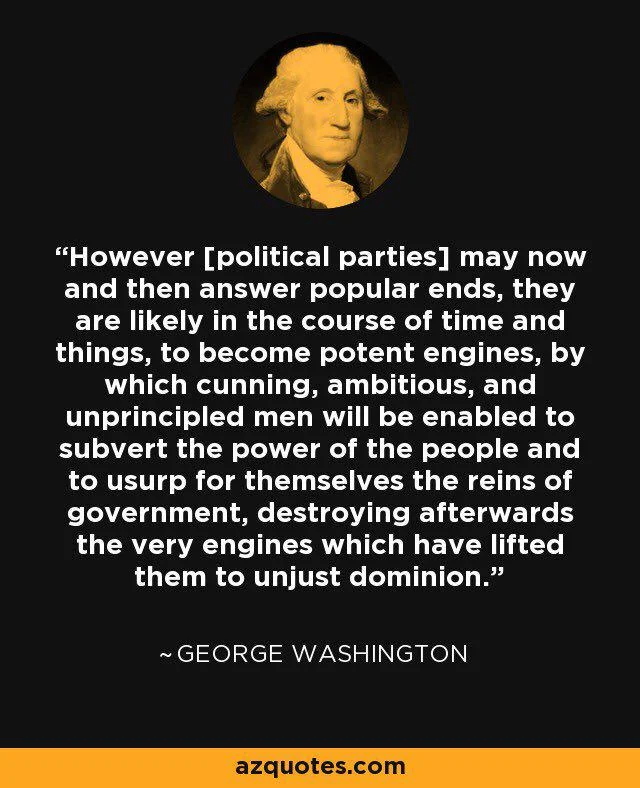
- George Washington: In his 1796 Farewell Address, he issued a stern warning that the “spirit of party” would lead to a “frightful despotism.” He argued that parties distract the government, agitate the community with “ill-founded jealousies,” and open the door to foreign influence and corruption.
- James Madison: In Federalist No. 10, Madison argued that the greatest threat to a republic was “faction.” He believed the new Constitution’s large, representative structure would help “break and control the violence of faction” by forcing different interests to negotiate.
- John Adams: He famously stated, “There is nothing which I dread so much as a division of the republic into two great parties… this, in my humble apprehension, is to be dreaded as the greatest political evil.”
2. Simone Weil’s Critique
You are correct about the French philosopher Simone Weil. In her 1943 essay, On the Abolition of All Political Parties, she made a radical argument based on truth and conscience.
She argued that political parties are “machines for generating collective passions.” According to Weil:
- They kill the truth: A party member is expected to support the party line even if they know it is wrong. This forces people to lie to themselves and others.
- They are “totalitarian in embryo”: The ultimate goal of every party is its own growth and power, not the public good.
- They replace thought with “labels”: People stop thinking about “what is just” and start thinking about “what does my party say?”
3. Other Famous Critics of “The Party Spirit”
Many other thinkers throughout history have argued that parties (or the “factional spirit”) are detrimental to a healthy society.
| Figure | Main Objection |
| Thomas Jefferson | Though he helped start a party, he famously said: “If I could not go to heaven but with a party, I would not go there at all.” |
| Moisei Ostrogorski | A political scientist who argued that permanent parties lead to “bossism” and corruption; he proposed temporary “issue-based” associations instead. |
| Karl Popper | While he supported democracy, he warned that the “two-party system” often forces voters to choose between two evils rather than expressing a nuanced will. |
| Sun Yat-sen | The founder of modern China initially hoped for a “party-less” government but eventually used a single-party model as a temporary “tutelage” phase, highlighting the struggle between the ideal and the practical. |
Why did they fail to stop them?
Most of these thinkers eventually realized that as long as people have the freedom to associate, they will naturally group together with those who share their interests.
The Founders hoped the “checks and balances” in the Constitution would be enough to keep these groups from becoming too powerful, but they underestimated how quickly the election process (like the Electoral College) would force people into two competing camps.
Leave a Reply
You must be logged in to post a comment.