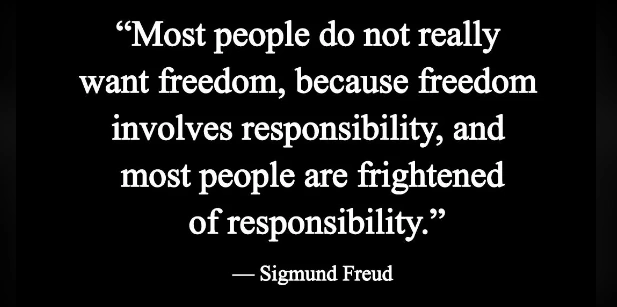
People have a natural aversion to being ruled by kings or dictators. Nobody wants to be a slave or a pawn in a game where others control our moves. We value our “freedom” and “self-determination” as the ultimate human state of being.
However, if we take a closer look at how we actually live, a different truth emerges: Freedom is exhausting.
The reality is that most of us don’t wake up craving a blank slate. Instead, we crave the certainty of being told what to do by those we trust. We want to live by a common set of rules that aren’t constantly changing.
The Weight of Autonomy
To truly practice self-determination, you have to become your own architect. You have to analyze the world from scratch, dismantle inherited biases, and build a personal code of ethics and conduct.
But the work doesn’t stop there. Once you’ve built your own set of rules, you face two massive hurdles:
Translation: You have to explain the why behind your rules to everyone you meet.
Validation: You have to convince the world to respect a “system of one.”
When you stand alone on your own principles, every disagreement becomes a personal battle. It’s no wonder that, for many, the “freedom” to choose feels more like a burden than a gift.
The Allure of the Pre-Defined
There is a profound, quiet relief in being told what to do by people you trust. This is why belonging to a community is so seductive.
When you join a group where the rules are already written:
The cognitive load vanishes: You don’t have to reinvent the wheel every morning.
Dissent is simplified: When conflict arises, you don’t need a complex philosophical defense; you simply point to “The Rules.”
Belonging is guaranteed: Following the script is the entry fee for acceptance.
The Easiest Path
Choosing to let others define the parameters of our lives isn’t necessarily a sign of weakness; it’s a survival strategy. It is by far the easier path to walk. It provides a safety net of shared expectations and a ready-made vocabulary for right and wrong.
While self-determination offers the peak of human potential, we must acknowledge the steepness of the climb. For most, the comfort of the valley—where the rules are clear and the community is settled—is more than enough.
The cost of belonging
When a community prioritizes the “ease” of following over the effort of self-determination, they create a vacuum. There is an opening for an autocratic leader to fill that vacuum, to expand and occupy every inch of it.
The danger lies in a psychological feedback loop: the more a leader changes the rules, the more the followers retreat into submission to avoid the “cost” of dissent.
1. The Erosion of the “Social Contract”
In a healthy community, rules are a shared agreement for mutual benefit. When a leader becomes an autocrat, they treat rules as tools of control rather than instruments of order.
Moving the Goalposts: By changing rules frequently to suit their personal needs, the leader ensures that no one else can ever be “right.”
The Benefit Shift: The metric of success moves from “Is the community thriving?” to “Is the leader satisfied?” This shift is often subtle, wrapped in the language of “protecting the group” or “maintaining stability.”
2. The Trap of “Learned Helplessness”
When followers place absolute faith in a leader, they often undergo a process called learned helplessness. This occurs when people feel that no matter what they do, they cannot influence the outcome of their lives.
Loss of Agency: Because it was “easier” to let the leader decide, the community’s “muscle” for critical thinking and self-governance atrophies.
Sunk Cost Fallacy: Having already invested significant trust and identity into the leader, followers may find it too painful to admit they were wrong. It is emotionally cheaper to keep believing the lie than to face the chaos of a broken system.
3. The Weaponization of Trust
An autocrat survives by turning the community’s best traits—loyalty and trust—against them.
Isolation of Dissent: If you have built your life around “pointing to the rules,” and the leader is the one who makes the rules, then any disagreement with the leader is framed as a betrayal of the community itself.
The Information Monopoly: The leader begins to filter what the community sees, ensuring that their personal benefit is always framed as a “necessary sacrifice” for the greater good.
4. The Fragility of the “Easy Path”
The ultimate danger is that a community built on blind submission is incredibly brittle. When the leader eventually fails (or the rules become too contradictory to follow), the community lacks the framework to rebuild. They have forgotten how to analyze, how to debate, and how to set their own rules.
The Way Forward
If we value our freedom, but accept our responsibility to each other, we mustn’t sign away our ability to question the leader and to have collective control over the rules which must always serve the greater good. Leaders must never be held up to be infallible. To question the wisdom of any changes to the rules is not an act of disloyalty, it is an act of collective self-determination.
“The price of apathy is to be ruled by evil men.”
Often attributed to Plato, this underscores that the “easiest path” eventually leads to the most difficult destination.
Leave a Reply
You must be logged in to post a comment.